

Building a strong website has become a priority for businesses in Ghana. As more people shop online, they seek clear information, easy payment options, and pages that load quickly.
A well-built website is no longer optional. It helps companies be reachable around the clock, attract new customers, and project a professional image.
In Ghana, good web design is becoming more than just a matter of aesthetics. Speed, hosting, security, mobile money, SEO, and the entire client experience are now included. When these components come together, a website becomes a true corporate asset that fosters expansion and nurtures confidence.
However, many Ghanaian businesses continue to have difficulties with the internet. Even though you have a website page, sales may seem to be sluggish and digital visibility might be low. What might be the cause of slow sales and low digital visibility? It is possible that your outdated website malfunctions, is not responsive on mobile devices, loads slowly, or lacks mobile money payment integration. When customers search for you, they come across your competition first. These discrepancies undermine confidence and reduce actual income. On average, new users spend about 30 seconds on a web page, and a poor layout or slow performance can lead to a high bounce rate, costing you potential sales
With an emphasis on practical decision-making, this guide provides an overview of website design in Ghana for 2026. It includes deciding on the best website type, planning the build, understanding hosting and costs, setting up online payments, selecting your hosting partner, and overseeing ongoing maintenance. Each section highlights the choices that directly affect performance, trust, and sustainable growth for Ghanaian businesses.
So, let's start by looking at how the website development landscape is shaping up across Ghana today.
The State of Website Development in Ghana
The digital world in Ghana is no longer just an idea for the future; it is happening right now. Ghana's internet use is rising fast, with over 24.3 million individuals online by the beginning of 2025, representing approximately 70% of the population. The profound level of connectivity is even more evident in mobile device adoption: according to the Digital 2025: Ghana report (DataReportal/GSMA Intelligence), there were 38.3 million active mobile connections in the country. This figure is equivalent to 110% of the total population, confirming that there are more mobile connections than people in the nation.
These facts form a single, fundamental truth. For Ghanaian businesses, having an online presence in the form of a website is now mandatory. It is where consumers come into contact with your brand.
Businesses use websites for:
- Showcasing products and services.
- Selling online and generating revenue (e-commerce, bookings, subscriptions).
- Reaching customers beyond their local area.
- Sharing contact details, updates, and brand story.
- Building credibility with reviews, testimonials, and other social proof.
As more Ghanaians shop, search, and work online, a website becomes the easiest way to reach them. New tools also make it easier for beginners to build simple sites. Drag-and-drop builders now allow people to create basic pages without coding.
These tools make things easier, but a strong online presence still needs planning. It starts with knowing how a website supports real business growth.
How a Strong Website Helps Ghanaian Businesses Grow
Many businesses in Ghana still treat a website as optional, even as more customers go online to search, compare options, and make decisions. This shift means a website now directly affects visibility, trust, and sales. When it is built well, it supports everyday business operations and creates new growth opportunities.
Here are some of the key benefits a strong website provides:
- Reach more customers. A website helps you connect with people beyond your immediate area.
- Build credibility. A clean, well-organized site builds trust and makes it easier for customers to choose you.
- Sell anytime. An online store or booking system keeps your business open 24/7.
- Serve as your marketing hub. Social media, ads, and Google searches can all lead customers back to one place: your website.
- Get better results from marketing. Campaigns perform better when they send people to a clear, persuasive page that converts.
- Learn what customers want. Analytics tools show what visitors are looking for, helping you improve your offers and grow.
Types of Websites Ghanaian Businesses Commonly Need
Every business works differently. Some sell products. Others offer services. Some rely on walk-in customers, while others depend on online enquiries. Because of this, the type of website a business needs depends on what it does, how customers usually find it, and what action the business wants visitors to take.
In Ghana, most business websites fall into a few common categories.
1. Brochure or Informational Websites
These are the most widely used websites among small and medium businesses. They are simple and focus on providing visitors with the information they need without unnecessary features.
Local shops, salons, consultants, tradespeople, small schools, and community groups commonly used them. The goal is not to do everything online, but to help people understand the business before making contact.
Most brochure sites include a main homepage, a short about section, details about services or products, and clear contact information such as phone numbers or WhatsApp. Some also show reviews or past work. This works well because many customers search online first and then decide whether to call, visit, or send a message.
2. Blog or content-driven websites
On many websites, information sharing takes precedence over direct commerce. They are based on articles, updates, or educational materials.
Media outlets, educators, coaches, non-governmental groups, and businesses that rely on search engines for traffic widely use them.
By providing helpful insights or responding to inquiries, these websites gradually establish trust rather than promoting sales.
When done well, content-driven websites help businesses stay visible in search results and attract visitors who are already interested in the topic.
3. E-commerce websites
E-commerce websites allow customers to browse products and make payments online. This type is becoming more common in Ghana as online shopping grows.
They are popular with fashion brands, electronics sellers, beauty businesses, food vendors, and lifestyle stores. Customers prefer sites that are easy to use and support familiar payment methods, especially mobile money, which increases confidence during checkout.
4. Corporate and Specialized Websites
Some organisations need more structured websites with specific tools. This is common for banks, universities, real estate companies, NGOs, and service platforms.
These websites often include extra sections such as portals, dashboards, booking tools, or learning systems. The focus is usually on providing ongoing access and information rather than quick enquiries.
Choosing the right type of website from the start makes everything easier. It helps with planning, keeps costs under control, and ensures the website supports the business instead of becoming a burden.
Having said that, let us take a look at the complete website development process in detail below.
The Website Development Process in Ghana: A Complete Breakdown
Building a website is not a single task. It is a set of clear steps that guide your project from planning to launch. When each phase is handled well, the final website loads fast and works smoothly. It also ranks in search and supports your long-term goals.
The steps below show how a typical website development project in Ghana progresses from early planning to a live site.
Step 1: Define the Purpose of Your Website
Every successful website starts with clarity. Before you begin designing or hosting a website, you must first understand why it exists. Ask yourself, why do I/we need a website?
- Who is my primary target clients?
- Which steps should visitors take?
- Do I want sales, leads, bookings, sign-ups, or awareness?
- Clear goals influence the design, features, and content.
If, as a business owner, you are still unsure about the value of a website, then you can explore the basics in Does Your Ghanaian Business Really Need a Website?
Why this step shapes the whole project:
A website built without a purpose becomes confusing. When visitors cannot find what they need, conversion drops. Focus keeps your project efficient and impactful.
Step 2: Plan Your Content and Your Page Structure
Once its purpose is clear, determining content follows. Content matters more than design at this stage. In Ghana, websites that work well usually start with clear information, not colours or layouts.
Most business websites end up needing a few basic pages:
- A landing page that quickly reveals the company's real purpose
- An About page that tells people who they are dealing with
- A page for services or products that provides concise explanations of offers without requiring users to contact for basic information
- A contact page that puts WhatsApp or a phone number front and centre, with a simple form if needed
- Extra pages added only when they serve a clear purpose, such as publishing updates, taking bookings, improving search visibility, or selling online
Instead of trying to say everything at once, focus on what a visitor would want to know first. This type of information organization makes the website easier to navigate and improves its overall performance.
Tip: Many users in Ghana browse on mobile phones. So, short paragraphs, clear headings, and scannable text make a big difference.
Step 3: Choose Your Design, Layout and User Experience
This stage shapes how your website looks and feels. Based on a small survey, a good website design in Ghana prioritizes clarity and a smooth mobile experience due to prevalent phone usage.
Key elements designers focus on:
- Clean layouts that guide the user
- Colors and fonts that match your brand
- Simple navigation menus
- Fast loading pages
- Mobile-first layouts, which are now a global standard
The rise of mobile usage in Ghana makes speed and simplicity very important. Across Africa, people are far less patient with slow websites, and many will leave if a page does not load quickly.
Step 4: Choose How You Will Build the Website
In Ghana, there are three primary ways to build a website. Every choice meets various demands and financial constraints.
Option A: Website Builders
Drag-and-drop tools let beginners create basic websites without coding. They are best for personal portfolios, small brochure websites, and startup companies.
Pros: quick setup, simple editing
Cons: limited flexibility, weaker SEO control, harder to scale
Option B: CMS Platforms Like WordPress
WordPress is a popular choice for enterprises in Ghana since it can be used for a variety of website requirements. Over time, it also continues to be simple to handle.
WordPress is ideal for business websites, blogs (SEO-focused), e-commerce shops using WooCommerce, service booking sites, NGO sites, and multi-page company websites among others.
Pros: highly flexible, strong SEO control, and easy to update
Cons: needs proper maintenance and hosting
Option C: Custom Development
The custom-coded websites are built from scratch. These are usually chosen by businesses that already know they need something more than a standard setup. Things like internal dashboards, user portals, or systems that need to connect with other software often fall into this category. Example: gregclaydavis.org is a custom website designed for a therapist. It includes a built-in booking and invoicing system and is designed to comply with Ireland’s GDPR requirements.
Pros: fully tailored, scalable, unlimited features
Cons: higher cost, longer timeline, requires technical support
Step 5: Build and Configure the Website
When you choose a platform, the technical building process begins. This stage brings together your content and design.
The key tasks include:
- Setting up hosting and a domain. Find additional information here on how to choose your domain type and hosting.
- Installing themes and plugins
- Designing page layouts
- Adding written content, images, and videos
- Configuring mobile responsiveness
- Setting up forms, payment tools, bookings, or e-commerce
A strong backend setup supports long-term performance. Also, good hosting makes your site load faster.
Step 6: Test Everything Before Launch
Testing protects your business from errors that can harm trust or sales. It also reduces customer complaints and improves first impressions.
You must check the following:
- Mobile layout (as most Ghanaian users browse on phones)
- Page speed
- All links and menus
- Forms and chat apps such as WhatsApp, Messenger, Tawk.to, etc.
- Payment integration. E.g. integrating mobile money, PayPal or card payments
- Checkout experience
- Browser compatibility
Step 7: Launch the Website and Promote It
Once everything is ready, it is time to go live.
Common launch tasks:
- Point the domain to the hosting server
- Verify the SSL certificate
- Submit sitemap to Google Search Console
- Share the website with customers
- Promote it through WhatsApp, social media, email, and Google Business Profile
Remember: Promotion is as important as the website itself. A great site with no visitors brings no results.
Factors Affecting Website Costs
Budget is one of the first questions every business owner asks. The truth is that website development costs in Ghana vary widely because each project has different needs. The price depends on the kind of site you want, the features you choose, and the level of expertise required to build and maintain it.
Here are the main factors that affect cost:
● Type of Website
Brochure sites are less expensive since they contain fewer pages and simpler functionalities. E-commerce shops, portals, and bespoke platforms are more expensive mainly because they require product systems, payment tools, dashboards, and extensive development.
● Features and Functionality
Booking tools, mobile money checkout, search filters, logins, dashboards, and multilingual material all enhance the effort. More features require more design time, testing, and a higher budget.
● Design Requirements
A simple layout costs less. A custom design with unique branding, animations, illustrations, or premium templates increases the price. Businesses in competitive industries often invest more here.
● E-commerce configuration
If your site needs an online store, expect extra costs for product setup, shipping rules, inventory systems, and mobile money integration. Payment gateways also charge transaction costs, which you must account for.
● Who Builds the Website
The ultimate cost is influenced by your decision to work with a professional business, a small agency, or a freelancer. Although experienced teams are more expensive, they often deliver better SEO, more reliable support, and better performance.
Beyond features, your hosting choice also affects cost and performance. It plays a significant role in how your website runs every day.
So let us break down why hosting matters and how it affects daily performance.
Strong hosting is the foundation of every website
Every website needs reliable hosting. It is the service that stores your files and delivers your site to visitors. Good hosting improves speed, uptime, and user experience. Whereas poor hosting can slow your site and cause errors during busy hours.
Learn more about web hosting and why it is essential for your website here.The main hosting types you will see
- Shared hosting for small and basic sites
- VPS hosting for growing businesses that need better performance
- Cloud hosting for projects that expect traffic spikes
- Dedicated servers for large websites or heavy applications
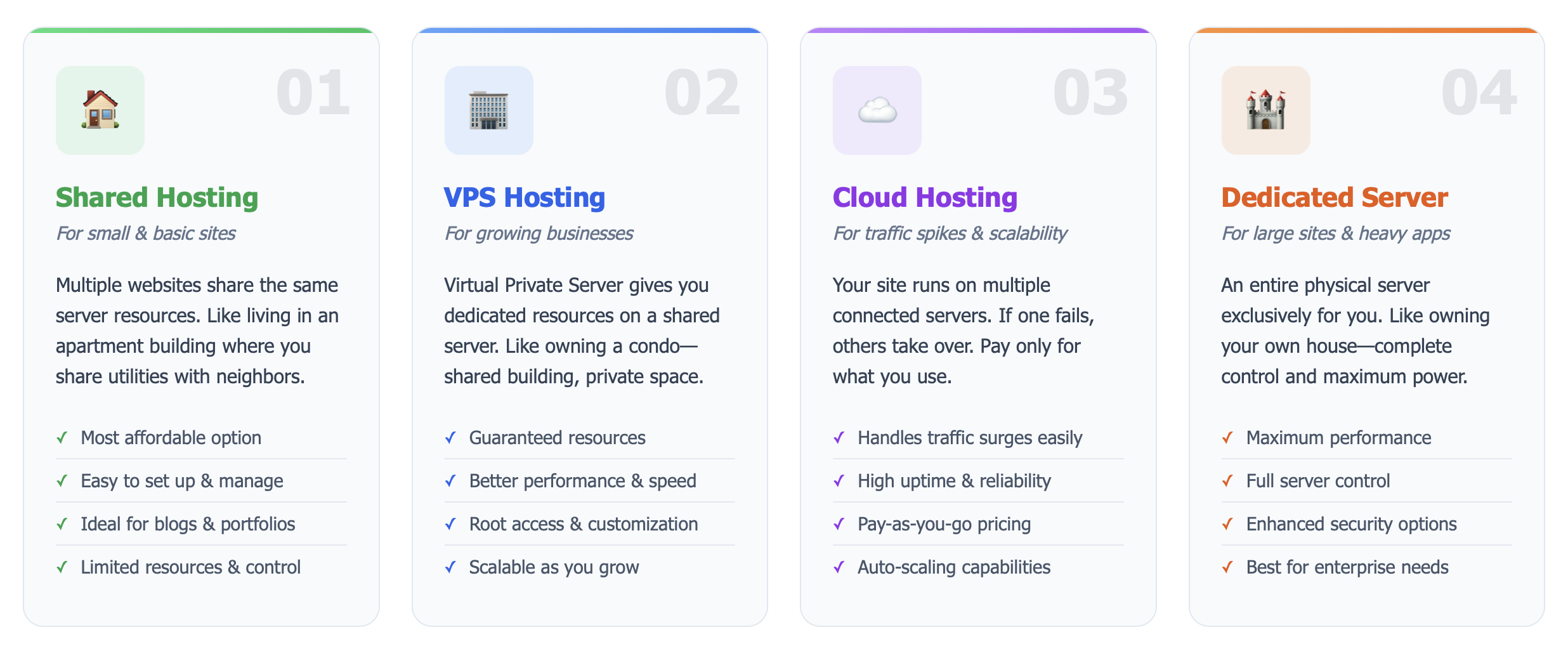 See how shared, VPS, cloud, and dedicated hosting work with a simple visual breakdown. Understand resources, performance, and cost so you can choose confidently.[/caption]
[caption id="attachment_841" align="aligncenter" width="2560"]
See how shared, VPS, cloud, and dedicated hosting work with a simple visual breakdown. Understand resources, performance, and cost so you can choose confidently.[/caption]
[caption id="attachment_841" align="aligncenter" width="2560"]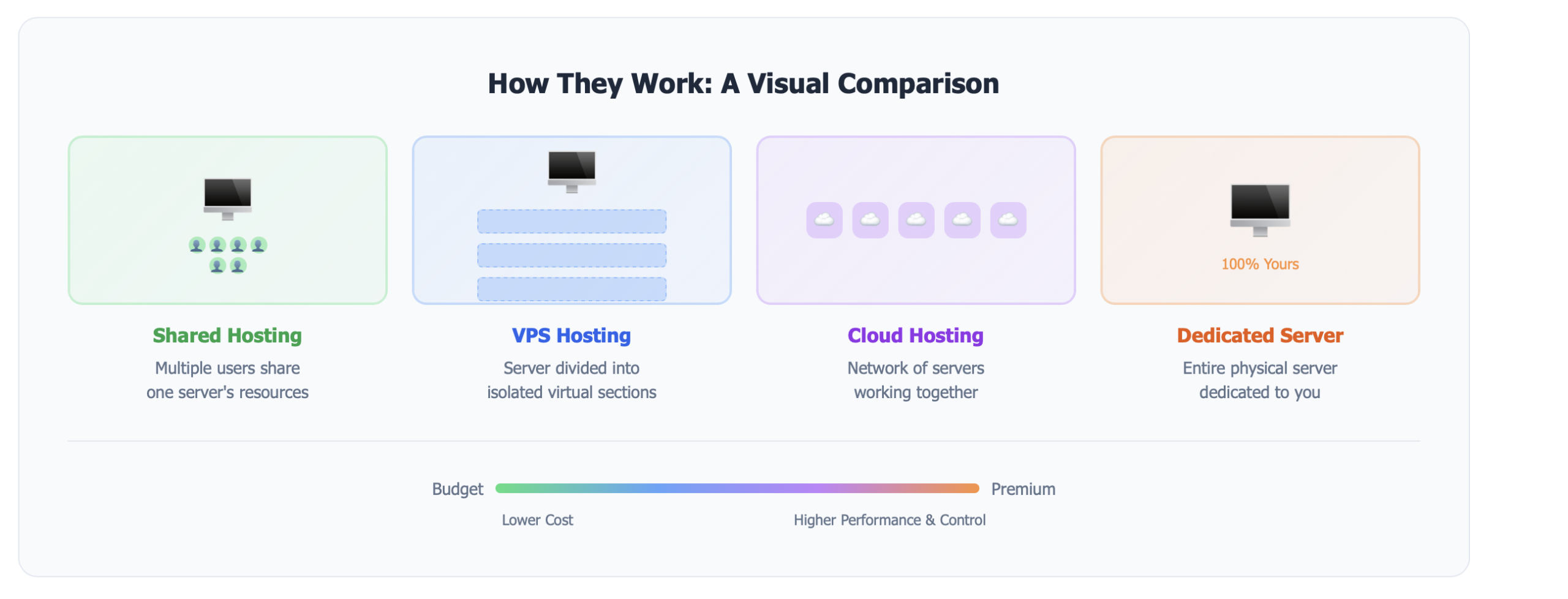 Compare shared, VPS, cloud, and dedicated hosting in one guide. Learn the key differences, benefits, and which option fits your website and budget.[/caption]
Ghana has both local and international hosts. Local hosting may load faster for Ghanaian users, while international hosts may offer stronger global infrastructure.
Many people struggle to choose the right host. This is why a detailed comparison, such as the best hosting providers in Ghana 2026, can help you see how each provider performs in real conditions, including uptime, server performance, and support.
Why WordPress Remains the Top Choice in Ghana
WordPress continues to dominate website development in Ghana because it gives business owners flexibility, control, and room to grow.
Over 43.2% of all websites worldwide are currently powered by WordPress. It shows the platform's growing trustworthiness and popularity. It is particularly well-liked in Ghana since it works well for both small and large enterprises, supports mobile-friendly design, and connects with regional payment systems. The platform also makes it easy for owners to update content, add new pages, or adjust their layout without needing advanced technical skills.
Why many Ghanaian businesses choose WordPress
- Simple editing tools that make updates fast
- Thousands of plugins for adding features
- Strong SEO support to rank higher on Google
- Smooth WooCommerce setup for online stores
- Easy mobile money plugin integration
- Affordable long-term maintenance
Are you still unsure which platform to choose? The WordPress step-by-step guide for Ghana explains the setup and shows when WordPress makes the most sense.
E-commerce Works Best When Mobile Money Is Built In
Online shopping has grown significantly in Ghana, and customers now expect a smooth checkout that supports the payment method they trust most. Mobile money is widely used across the country, so building an e-commerce website with mobile money is often the best way to match how people prefer to buy.
What to plan before launching an online store
- Product structure that supports low-data connections and mobile browsing
- Delivery costs and shipping zones for places like Takoradi, Kumasi, Accra, and neighboring locations
- Checkout design suited for phones, as the majority of orders are placed on mobile.
- Testing of card payments and mobile money on MTN MoMo, Vodafone Cash, and AirtelTigo
- Order notifications sent through SMS, email, or WhatsApp for local customers
- Inventory controls that reflect real stock levels to avoid delivery issues
A reliable mobile money integration setup also reduces abandoned carts, since customers complete their orders faster when the process feels familiar.
Why choosing the right web design partner makes a big difference
Selecting a partner who understands how Ghanaians browse, search, and make decisions is important, since your website is a long-term asset. The ideal team can demonstrate actual work they have finished, communicate effectively, and establish reasonable deadlines.
With the rise of digital services, reports show that many businesses in Ghana have faced issues with fake or unreliable "web designers" who disappear after taking payment. This makes it even more important to work with a team you can completely trust.
A reliable web design company in Ghana can guide you through the proper structure, features, and tools your website requires to enable actual business success.
What to check before hiring anyone
- Examples of Ghana-based projects, preferably in your industry or with local payment setups
- Clear timelines tied to real delivery milestones and not vague promises
- Transparent pricing in local terms, including what is and is not included
- Ongoing support and maintenance options, not just a one-time build
- Strong understanding of mobile-first design, local search behaviour, and SEO in Ghana, where most users browse on phones
Websites Need Ongoing Care After Launch
A website must be maintained like any other business tool. Without regular updates and security checks, it can become slow, outdated, or vulnerable to attacks. Consistent care keeps your site secure and performing well.
Maintenance tasks you should expect
- Updating plugins and core software
- Monitoring security
- Running backups
- Checking site speed
- Refreshing content or adding new pages
Website maintenance costs in Ghana help business owners understand what to expect after launch and plan for the updates, security checks, and backups their site will need.
Industry-Specific Considerations Matter More Than Most People Realize
Every industry in Ghana has its own online needs, and a website should reflect how people in that field search, decide, and take action.
What works on one website can feel completely wrong on another. A restaurant needs menus and bookings. A school needs space for updates, schedules, and notices. An NGO also has very different priorities than a retail shop, so using the same layout across all of them rarely works.
Since trust and openness are the most critical factors, NGO and non-profit websites often devote more space to donations, project updates and volunteer information. Also, real estate websites use a distinct strategy. They prioritize search filters, maps, and photo galleries so that individuals can evaluate homes before reaching out.
Marketplaces need vendor dashboards and product management tools, while schools and training centers benefit from student portals, course materials, and announcement sections. Service businesses often rely on booking systems and WhatsApp contact buttons, and e-commerce brands need smooth mobile money checkout, product filters, and delivery zone setup.
Recognizing these differences early helps you choose the right structure and features from the start, making your website more effective for your specific industry and audience.
A Strong Online Presence Begins with the Right Decisions
A successful website development in Ghana for 2026 is the result of a few good decisions made at the right time. Choices about structure, hosting, payments, performance, and ongoing care all affect how well a site supports real business growth in Ghana.
For businesses that want practical, hands-on support, Faciotech works closely with Ghanaian companies to plan, build, and improve websites that are reliable, easy to manage, and designed to grow over time.
Whether you are starting fresh or improving an existing site, you can reach out to Faciotech to work with a team that understands the local market and focuses on outcomes, not just design.
Related Faciotech Services
- Website Design — Custom website design and development services
- Software Development — Bespoke software and web application development
- Small Business IT — IT solutions tailored for small businesses in Ghana